
Did King Saul Go to Paradise After He Died?
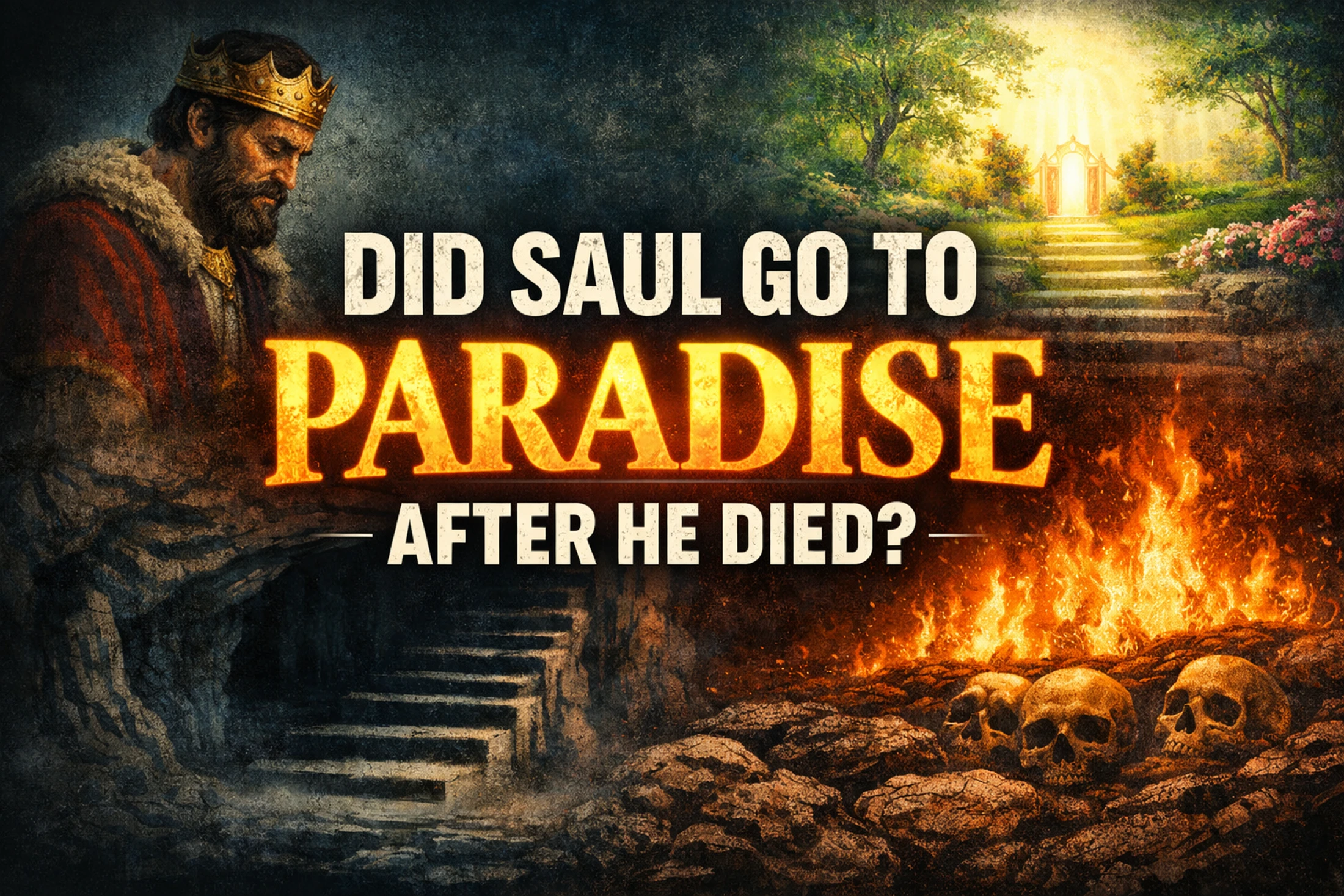
TL;DR: King Saul’s Final State
King Saul was chosen and anointed by God, but he drifted into disobedience and died without clear repentance. The Scripture points toward judgment, not restoration.
The Two Primary Views:
1. Saul Was Among the Righteous (Paradise)
This view argues:
- Saul was chosen by God (1 Samuel 9:15–16)
- God “changed his heart” (1 Samuel 10:9)
- The Spirit came upon him and he prophesied (1 Samuel 10:10)
- Samuel said Saul and his sons would be “with me,” and since Jonathan was among them and is understood to be righteous, some conclude they shared the same destination (1 Samuel 28:19)
From this, some conclude Saul was among the righteous dead.
2. Saul Was Not Among the Righteous
This view argues:
- Saul was empowered (anointed) for kingship, not necessarily justified before God (1 Samuel 9:16, 1 Samuel 10:1, 1 Samuel 10:6)
- Saul was rejected by God for his disobedience (1 Samuel 15:26, 1 Samuel 15:28)
- His life shows a consistent pattern of disobedience and hardening rather than repentance (1 Samuel 13:13–14, 1 Samuel 15:22–23, 1 Samuel 15:30)
- The Spirit of the LORD departed from him (1 Samuel 16:14)
- He turned to a witch when God would not answer him, and ultimately died in battle by his own hand (1 Samuel 28:6–7, 1 Samuel 31:4)
- Scripture summarizes his death as judgment for transgression, not as a man finishing in faith (1 Chronicles 10:13–14)
From this, others conclude that Saul was anointed by God for a role but ultimately rejected God and died in rebellion, leaving no biblical basis to place him among the righteous.
What Happened to Saul Early in His Life
Saul’s beginning is often used to argue that he was spiritually changed in a saving sense.
- 1 Samuel 10:6–9, “And the Spirit of the LORD will come upon thee, and thou shalt prophesy with them, and shalt be turned into another man. And let it be, when these signs are come unto thee, that thou do as occasion serve thee; for God is with thee…And it was so, that when he had turned his back to go from Samuel, God gave him another heart…”
- 1 Samuel 10:10, “And when they came thither to the hill, behold, a company of prophets met him; and the Spirit of God came upon him, and he prophesied among them.”
These passages clearly show:
- The Spirit came upon Saul
- He was changed
- He prophesied
The question is not whether Saul was changed but what kind of change this was.
The Nature of the Spirit in the Old Testament
In the Old Testament, the Spirit of God often came upon individuals for specific purposes. This is distinct from the New Testament pattern of permanent indwelling. The following examples establish a consistent pattern that the Spirit coming upon a man in the Old Testament was for empowerment and purpose, not necessarily a declaration that he was righteous before God.
Key examples:
Balaam - Numbers 24:2, “And the Spirit of God came upon him.”
Yet Balaam is later condemned (Numbers 31:16).
Cyrus - Isaiah 45:1, 4–5, “Thus saith the LORD to his anointed, to Cyrus……I have even called thee by thy name: I have surnamed thee, though thou hast not known me.”
These examples establish a consistent pattern:
- God empowers men
- God uses men
- God changes men for a purpose
But this does not automatically mean:
- They are justified
- They are among the righteous
This framework fits Saul’s experience in 1 Samuel 10, where the Spirit came upon him and he was changed for the purpose of kingship, but the text never clearly states that this was a "saving" or permanent work that placed him among the righteous.
One of the most significant verses in this discussion is:
1 Samuel 16:14, “But the Spirit of the LORD departed from Saul, and an evil spirit from the LORD troubled him.”
But if it was just empowerment for kingship, the passage is perfectly consistent.
The Turning Point in Saul’s Life
Saul’s decline becomes clear in 1 Samuel 15.
1 Samuel 15:22–23, “And Samuel said, Hath the LORD as great delight in burnt offerings and sacrifices, as in obeying the voice of the LORD? Behold, to obey is better than sacrifice…For rebellion is as the sin of witchcraft, and stubbornness is as iniquity and idolatry…”
Saul’s pattern is not simply failure, it is:
- Partial obedience
- Excuses instead of repentance
- Concern for reputation over obedience (1 Samuel 15:30)
Saul’s Final Condition
Saul’s end reveals the direction of his life.
1 Samuel 28:6, “And when Saul inquired of the LORD, the LORD answered him not…”
Instead of repentance, Saul turns elsewhere.
1 Samuel 28:7, “Then said Saul unto his servants, Seek me a woman that hath a familiar spirit…”
This is the same sin earlier described as rebellion (1 Samuel 15:23).
God’s final summary of Saul’s life removes uncertainty:
1 Chronicles 10:13–14, “So Saul died for his transgression which he committed against the LORD…and also for asking counsel of one that had a familiar spirit, to inquire of it; And inquired not of the LORD…”
God is telling us plainly that Saul died under judgment.
A Deeper Study for Those Who Want to Go Further...
The strongest argument for Saul being among the righteous is found here:
1 Samuel 28:19, “Moreover the LORD will also deliver Israel with thee into the hand of the Philistines: and to morrow shalt thou and thy sons be with me…”
In this scripture Samuel is declaring that Saul will die and join him in the place of the dead, but the wording does not define where within that realm Saul will be.
The phrase “with me” must be interpreted carefully.
In the Old Testament:
- The dead went to Sheol, the place of the dead
- This realm is later revealed to have distinction within it
Luke 16:22–23, “The rich man also died, and was buried; And in hell he lift up his eyes, being in torments…And in Abraham’s bosom…”
This shows the place of the dead having two compartments:
- (1) A place of comfort (Abraham’s bosom, Paradise)
- (2) A place of torment
- Both within the same realm, separated by a great gulf (Luke 16:26)
Therefore, “with me” indicates the same place of the dead, not necessarily the same place or condition within that realm.
Paradise, Sheol, and Their Relocation
Before the resurrection of Christ:
- The righteous dead were in Paradise (Abraham’s bosom)
- The wicked were in torment
After Christ’s work:
Ephesians 4:8–10, “When he ascended up on high, he led captivity captive…”
Acts 2:31, “He seeing this before spake of the resurrection of Christ, that his soul was not left in hell, neither his flesh did see corruption.”
This is understood as:
- Christ entered Sheol and was not left there
- This took place between His death and resurrection, before His ascension to Heaven
- He led the righteous out from that place
- This is the relocation of Paradise from the lower parts of the earth to Heaven
This distinction matters because:
- Being in Sheol does not automatically mean being in Paradise.
Old Testament Salvation Clarified
Old Testament salvation involved:
- Faith in God, plus
- Obedience under the law
Yet:
- No one perfectly kept the law
- Righteousness still required a heart toward God
The consistent pattern of the righteous:
- They return to God when they fail
- They maintain a posture of faith
The pattern of Saul:
- Increasing distance from God
- No clear moment of repentance at the end
- Final actions rooted in rebellion
Final Conclusion
Saul was:
- Chosen by God
- Empowered by the Spirit
- Used for a specific purpose
But Scripture also shows:
- Saul rejected God’s command and was rejected from being king (1 Samuel 15:26–28)
- The Spirit of the LORD departed from him (1 Samuel 16:14)
- His life moved in a consistent direction of disobedience rather than repentance
- He turned to a witch when God would not answer him (1 Samuel 28:6–7)
- He died in that condition, by his own hand in battle (1 Samuel 31:4)
- God’s own summary states he died in his transgression (1 Chronicles 10:13–14)
While some argue that Saul was among the righteous based on: his early experiences and the phrase “with me,” spoken by Samuel, these do not provide sufficient biblical evidence to establish that conclusion.
The pattern of Saul’s life aligns far more closely with a man who was empowered for a role, but not sustained in faith.